
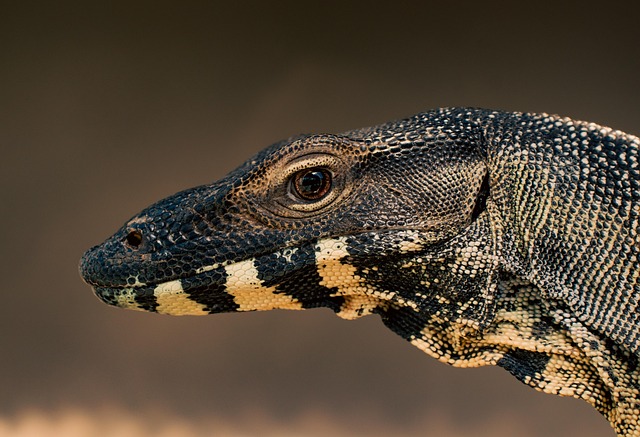
Imagine trudging through the rugged, sun-scorched savanna of Far North Queensland, clambering over sandstone escarpments that few vehicles can reach — and spotting a lizard with a blazing orange head staring back at you from a rock crevice.
That's exactly what happened to the team led by Dr Stephen Zozaya, a research fellow at the Australian National University (ANU), when his colleague Wes Read stumbled upon what would become one of the most striking reptile discoveries in recent Australian history.
"I was like, 'What is that?'" Dr Zozaya told ABC News. "I had no idea these things existed."
Three species, millions of years in the making
The orange-headed rock monitor, now formally named Varanus umbra, is the headline act — but it shares the stage with two equally remarkable cousins. Together, the trio described in the Zoological Journal of the Linnean Society are the first rock-adapted monitor lizards ever formally recorded from the eastern Australian savannas.
There's Varanus phosphoros, the yellow-headed rock monitor, found along a strip of granite habitat stretching from west of Cairns up to Cape Melville, where lush rainforest gives way to drier country. Then there's Varanus iridis, the rainbow rock monitor, which lives on granite-bouldered landscapes more than 200 kilometres inland from Cairns, near scenic spots like Cobbold Gorge.
And yes — all three species names refer to light, a nod to their dazzling, distinct colouration.
"We were blown away when the first genetic results came back," Dr Zozaya said. "These three species are more distinct from one another than many monitor species that have been recognised for decades."
What researchers initially assumed was a single, variable species turned out to be three separate evolutionary lineages that have been diverging independently for millions of years. These aren't distant cousins of obscure insects — they belong to the same iconic lizard family as the Komodo dragon.
Hiding in plain sight
Here's the twist: local wildlife enthusiasts already knew about these lizards. Photos had appeared online. But nobody in the scientific community had examined genetic material or museum specimens — because there weren't any.
"They hadn't really attracted the attention of researchers who work on monitor lizards," Dr Zozaya explained. It took dedicated fieldwork in some of Queensland's most remote terrain to collect the samples that proved these were genuinely new to science.
Professor Lin Schwarzkopf, a distinguished zoologist not involved in the study, said the discovery highlights how Queensland's dry savannas remain "understudied and underloved" compared to the state's famous rainforests.
"The fauna up here is really poorly known," she told ABC News. "It's not unusual for people to discover a new species right there on people's doorsteps."
A hopeful discovery — with a note of caution
In an era when extinction headlines dominate the news, finding three large, charismatic reptiles that science didn't even know about feels like a gift.
The good news is that all three species were documented in remote, rugged country — areas unsuitable for cattle grazing and largely inaccessible by road. Their populations are likely healthy, for now.
But there are concerns. Evidence already suggests the yellow-headed rock monitor has been illegally traded as an exotic pet. Co-lead author Wesley Read, an ANU PhD researcher, warned that even well-meaning searchers can cause harm.
"Even slight rock displacement can make a shelter unusable," Read said. "There's also a poaching risk, and we've already seen photos on social media showing some of these lizards in captivity."
Still, Dr Zozaya sees a silver lining in making the discovery public: it gives land managers and conservationists the information they need to protect these animals before they become threatened.
"These three species suggest there may still be a lot left to discover in northern Australia," he said, "even when it comes to large reptiles."
Somewhere in the rocky outcrops of Far North Queensland, an orange-headed monitor is basking in the sun — finally known to the world, and all the more wondrous for having waited so long to be found.