

It was 15 degrees in Ashland, Virginia, and Dan DiCandilo was having second thoughts about the morning walk. His dog Gozier was not. She stood by the front door, staring out the window, ready to go — same as every other day for the past nine years.
"That was a rough morning," DiCandilo said. "If she wasn't standing by the door, looking out the window, I probably wouldn't have gone. But she really doesn't care how cold it is."
So out they went, into the bitter February cold, for their regular five-mile loop through the quiet streets of this small Virginia railroad town.
A bark he'd never heard before
About 20 minutes in, as they walked along Henry Clay Road, Gozier suddenly began barking — but not her usual bark.
"The bark was a different bark in that it had a little bit of a cry to it," DiCandilo said. "I tried to pull her. I said, 'come on, Gozier, let's go,' and she resisted."
Her attention was fixed on what appeared to be a pile of snow on the front steps of a nearby home. DiCandilo stepped closer. It wasn't snow.
"It was a woman in a white robe, and she was barely moving, really struggling," he said. "She had no hat, she had no gloves, she had no shoes."
The woman's white robe had camouflaged her against the snow-covered ground, making her nearly invisible from the road. Without Gozier's insistence, DiCandilo said he would have walked right past.
Three hours in the cold
DiCandilo called 911 immediately and alerted the homeowner, who didn't recognize the woman. A neighbor's doorbell camera later showed she had arrived at around 4:15 a.m., meaning she had been lying in sub-freezing temperatures for roughly three hours before Gozier found her.
The woman's body temperature had plummeted to 78°F — classified as severe hypothermia. Normal body temperature is 98.6°F; at 78 degrees, organs begin to fail.
She lived next door to the house where she was found. She suffered from Alzheimer's disease and was known to try to leave her home during the night, DiCandilo later learned.
He said Gozier kept barking at the woman as if trying to wake her, staying close until emergency services arrived.
"My little girl"
The woman was rushed to hospital and released after a few days of treatment. Thanks to Gozier's persistence, she survived.
Word of the rescue spread quickly through Ashland, and DiCandilo soon received a call from the Town Council. At its meeting on Tuesday evening, March 3, the town formally recognized Gozier for her role in saving a life.
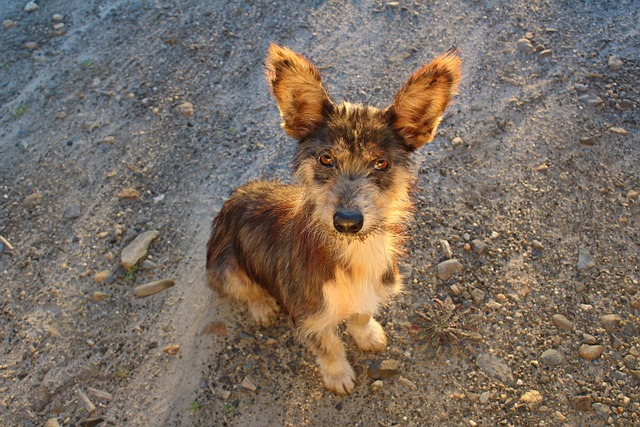
DiCandilo, who describes Gozier — a mixed-breed dog — as "the child we've never had," said the moment reinforced something simple but important.
"If you see something out there that doesn't look right, don't ignore it," he said. "I would have ignored it if it wasn't for Gozier, and something much worse could have happened."
Dogs are known to detect human distress through scent and sound cues invisible to us — changes in body chemistry, irregular breathing, even drops in body temperature. Whatever Gozier sensed that morning, she refused to let it go.
"Dogs are special. They have that sense that we don't have," DiCandilo said. "It's like a proud father — that's my little girl."