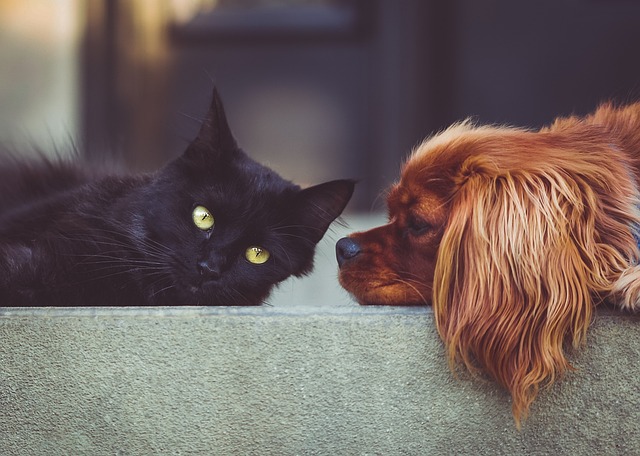
In 1999, a crow in a Massachusetts garden began feeding a stray kitten — bringing it scraps and standing guard while it ate. The pair were inseparable for months, grooming, playing, and sleeping side by side. The footage, captured by a bewildered homeowner, became one of the earliest viral animal videos. A quarter of a century later, the internet's appetite for such stories has only grown. But scientists are now asking a far more interesting question than "isn't that adorable?" They want to know: why does it happen at all?
The examples are everywhere, and they are wonderfully strange. In Colorado, a 700-pound potbellied pig called Hammie hikes five miles daily with Gus, a black Labrador who nudges her up rocky inclines. In a family's back garden, Ziva the Rottweiler — a rescue dog with her own difficult past — broods over a clutch of duck eggs until they hatch, then herds the ducklings across the lawn as though they were her own pups.
And then there is the programme that turned a quirky observation into a conservation tool. In 1976, research scientist Laurie Marker was hand-rearing a lonely cheetah cub called Khayam at Wildlife Safari in Oregon. With no other cubs available, she paired Khayam with a Labrador-mix puppy named Shesho. The result was transformative.
"Companion dogs act as a surrogate for cheetah siblings," Marker has explained. "It is the friendship between the two individuals that creates a strong bond."
Today, cheetah-dog pairings are standard practice at zoos across the United States. The Columbus Zoo alone houses 16 cheetahs alongside four companion dogs. "The cheetah would rather flee than fight," says Suzi Rapp, the zoo's vice president of animal programmes. "Dogs are everyone's best friend. Cheetahs soak that in." The pairings dramatically reduce stress and improve breeding prospects — critical for a species whose wild population has plummeted by more than 90 per cent since 1900.
The chemistry of unlikely bonds
The science behind these friendships is increasingly well understood, and it centres on a molecule familiar to anyone who has ever cuddled a newborn. Oxytocin, the so-called "love hormone," appears to play a crucial role not merely in whether animals are sociable, but in who they choose to bond with.
Research published in Current Biology in August 2025 by a team at the University of California, Berkeley, led by neuroscientist Annaliese Beery, found that prairie voles lacking oxytocin receptors took up to a week to form the selective peer preferences that normal voles established within a single day. More strikingly, in group settings the oxytocin-deficient animals simply could not keep track of their friends.
"Oxytocin is playing a crucial role not so much in how social they are, but more in who they are social with — their selectivity," Beery said. The implication is significant: the same neurochemical system that drives human attachment may be the engine behind a Rottweiler's devotion to her ducklings or a dog's calming influence on a captive cheetah.
Meanwhile, a separate 2025 paper in Current Biology from an interdisciplinary team including biologist Eduardo Sampaio explored how interspecies partnerships — from cleaner fish on coral reefs to octopuses hunting collaboratively with reef fish — demand sophisticated cognitive abilities, including reading behavioural cues across species boundaries. These are not simple reflexes. They require animals to interpret, adapt, and communicate with creatures whose evolutionary history diverged from their own millions of years ago.
Closer to home
Scotland has its own tradition of caring for animals thrown together by circumstance. Hessilhead Wildlife Rescue Centre in Beith, North Ayrshire, has spent more than 35 years treating injured and orphaned wildlife across its 20-acre site of woodland, marshland, and open water. With more than 60 outdoor enclosures housing everything from hedgehogs to seals, the centre regularly brings together species that would never cross paths in the wild — and staff have long observed that unexpected bonds can form during rehabilitation.
Researchers at Edinburgh's Royal (Dick) School of Veterinary Studies, home to one of the UK's leading programmes in applied animal behaviour and welfare, continue to explore the mechanisms behind such attachments. The question that lingers is whether these friendships are charming accidents or evidence of something deeper.
The emerging science suggests the latter. Social bonding, it turns out, may be less about species membership and more about shared vulnerability, proximity, and neurochemistry — forces that operate across the animal kingdom with a universality that should give us pause.
As Laurie Marker, the woman who first handed a cheetah cub a puppy for company nearly half a century ago, puts it: "It is the friendship between the two individuals that creates a strong bond."
Some things, it seems, transcend biology.