

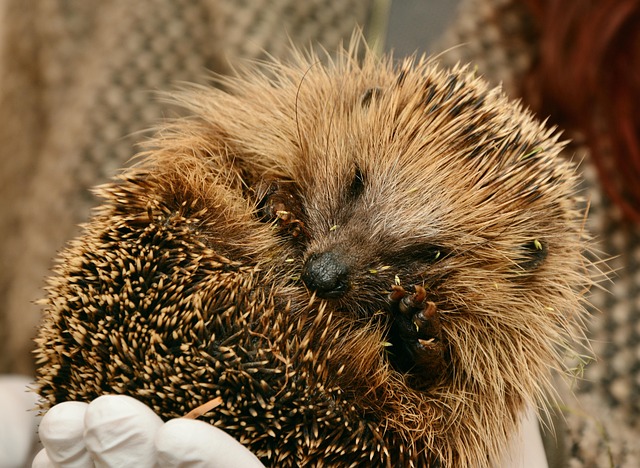
There are moments when one's alma mater makes one particularly proud, and this, I confess, is one of them. Researchers at the University of Oxford have discovered that the humble European hedgehog — that most quintessentially British of creatures — possesses a remarkable hidden talent: it can hear ultrasound at frequencies far beyond the range of human ears or even the family dog.
The discovery, published in the journal Biology Letters, could prove transformative for a species in desperate trouble. The European hedgehog was reclassified as "near threatened" by the International Union for Conservation of Nature in 2024, with populations declining by up to a third across Europe over the past decade. In Britain's countryside, the picture is grimmer still — numbers have fallen by as much as 75% since 2000.
Road traffic is a major culprit. Up to one in three hedgehogs in local populations is estimated to be killed by vehicles, their instinctive response to danger — curling into a tight, spiny ball — being rather less effective against a Ford Transit than against a fox.
A Remarkable Ear
The Oxford team, led by Dr Sophie Lund Rasmussen of the Wildlife Conservation Research Unit, collaborated with Danish colleagues to test the hearing of 20 rehabilitated hedgehogs using electrodes that measured electrical signals between the inner ear and the brain.
The results were striking. Hedgehog brainstems responded to sounds across a range of 4 to 85 kilohertz, with peak sensitivity around 40kHz — well into the ultrasound range, which begins above 20kHz. By comparison, humans hear up to 20kHz and dogs manage roughly 45kHz.
High-resolution micro-CT scans of a hedgehog's ear revealed the anatomical secrets behind this ability: unusually small, dense middle-ear bones and a partly fused joint that creates a stiffer chain, efficiently transmitting high-pitched sounds. These are features shared with echolocating bats — a remarkable piece of convergent evolution in an animal more commonly associated with shuffling through flowerbeds.
A Humane Solution
The practical implications are significant. Because hedgehogs hear frequencies well above those detected by domestic pets, it should be possible to design ultrasonic repellers for vehicles, robotic lawnmowers and garden strimmers that deter hedgehogs without disturbing cats, dogs or their owners.
"Having discovered that hedgehogs can hear in ultrasound, the next stage will be to find collaborators within the car industry to fund and design sound repellents for cars," said Dr Rasmussen. "This could have a significant impact in reducing the threat of road traffic to the declining European hedgehog."
Fay Vass, chief executive of the British Hedgehog Preservation Society, has long urged the public to become "hedgehog champions," noting that "small, simple actions can have a huge impact on habitat availability, connectivity and quality."
Closer to Home
The hedgehog's plight resonates keenly in Scotland, where dedicated rescue centres are fighting to keep the species going. Hogwatch Dumbarton, a volunteer-run charity founded in 2021 in the heart of Dumbarton, has rehabilitated hundreds of hedgehogs — including Hercules, a tiny 69-gram hoglet admitted in 2024 who battled ringworm, dental problems and an abscess before reaching a healthy release weight of 900 grams.
Hogwatch is a founding member of the Scottish Hedgehog Rescue Alliance, a collaboration of rehabilitation organisations ensuring that hedgehogs in need always have a place in rescue.
It is a very British story: a much-loved animal in quiet decline, clever scientists at a world-class university, and an army of volunteers in places like Dumbarton refusing to let it disappear. If the car industry has any sense — and any heart — it will answer Dr Rasmussen's call.
The hedgehog has survived 15 million years of evolution. It would be an unforgivable shame to lose it to the school run.