
You will almost certainly never see one. That is rather the point.
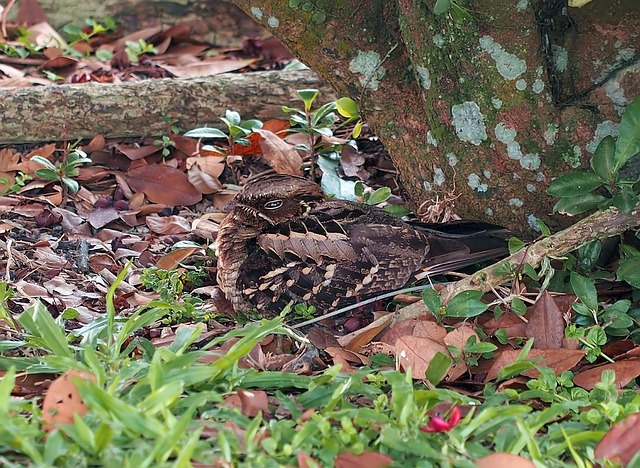
The European nightjar — Caprimulgus europaeus — is a bird designed by nature to be invisible. By day it lies motionless on the forest floor, its grey-brown mottled plumage so uncannily like a piece of dead bark that you could step within inches and never know it was there. It does not flinch. It does not blink. It simply is the ground.
But wait for dusk on a warm summer evening on the lowland heaths of southern England, and everything changes. As the light drains from the sky, the nightjar stirs. And then you hear it: a low, mechanical churring, rising and falling like some ancient engine warming up in the gloaming. It is one of the most otherworldly sounds in British nature — and, thanks to years of painstaking conservation work, it is being heard more often than at any time in a generation.
A survey conducted last year within the South Downs National Park recorded 78 nightjars — believed to represent a doubling of the population in just five years. Across the park's lowland heaths, 109 nightjar territories were identified, the highest number ever recorded. Meanwhile, RSPB reserves across the UK counted a record 211 individuals in 2024, a seven per cent increase on the previous high set in 2021.
"It's wonderful to hear the nightjars churring away as dusk falls," said Kirsty Murray, an engagement ranger for the South Downs National Park Authority. She described the lowland heaths where nightjars breed as "as rare as rainforest" in Britain — a habitat that now makes up just one per cent of the national park.
From Red to Amber
The recovery is all the more remarkable given how close the nightjar came to disappearing from much of its range. Numbers fell by 51 per cent between 1972 and 1992 as heathland was lost to agriculture and development. More than 80 per cent of Britain's lowland heathland has vanished since the 1800s.
The turnaround has been driven by targeted habitat restoration — clearing invasive scrub, reconnecting fragmented heaths, and working with visitors to protect the nightjar's vulnerable ground nests. At RSPB Minsmere in Suffolk, 24 churring males were counted in 2024, the highest number since 1996. At Arne in Dorset, free-ranging cattle, ponies and pigs have helped maintain a mosaic of heathland across 1,300 hectares, supporting 93 nightjars.
The species has been reclassified from the Red List to the Amber List on the Birds of Conservation Concern — a significant vote of confidence in the recovery.
A Scottish frontier
The nightjar's comeback is not confined to the south. Scotland, where the species sits at the northern edge of its breeding range, is seeing encouraging signs of its own.
Core breeding populations persist in Dumfries and Galloway and the Scottish Borders, while in 2024 chicks hatched in Aberdeenshire for the first time in nearly a century — the furthest north in Britain for decades.
"We're very excited to have already located one churring nightjar in breeding habitat in the Borders," said Dr Gavin Paterson of the Scottish Ornithologists' Club, which is using audio recording equipment to track the elusive birds across south-east Scotland. "This gives us great encouragement that more of these fascinating birds might be found if we keep recording."
The species is believed to be significantly under-recorded in Scotland, where vast swathes of suitable forested habitat have gone unsurveyed. With the Scottish Parliament's passage of the Natural Environment (Scotland) Bill — which sets statutory targets to make Scotland "nature positive" by 2030 and substantially restore nature by 2045 — conservationists hope the nightjar's northward progress will be actively supported.
A bird worth staying up for
The nightjar arrives each spring after a 4,000-mile migration from the Democratic Republic of the Congo. It feeds on the wing, scooping moths and beetles from the air with its wide, bristle-fringed mouth. The ancients believed it stole milk from goats — hence its Latin name, Caprimulgus, "the goatsucker."
The reality is rather less sinister, and rather more wonderful. This is a bird that has survived centuries of superstition and decades of habitat loss, and is now, quietly and invisibly, coming home.
Nick Forster, site manager at RSPB Minsmere, put it simply: "Connecting fragmented heathland has given species like the nightjar space to thrive."
On warm evenings this summer, on the heaths and forest edges of Britain, that strange mechanical churring will fill the air once more. Most of us will never see the bird that makes it. But knowing it is there — and that there are more of them than at any time in living memory — is rather the point.