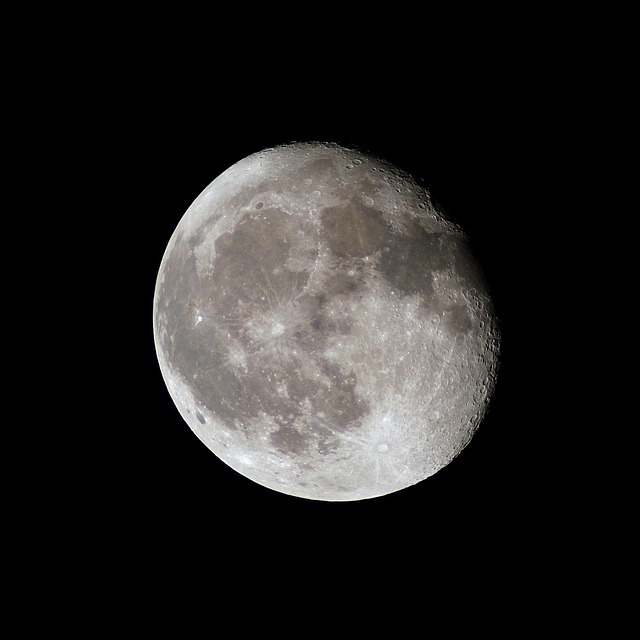

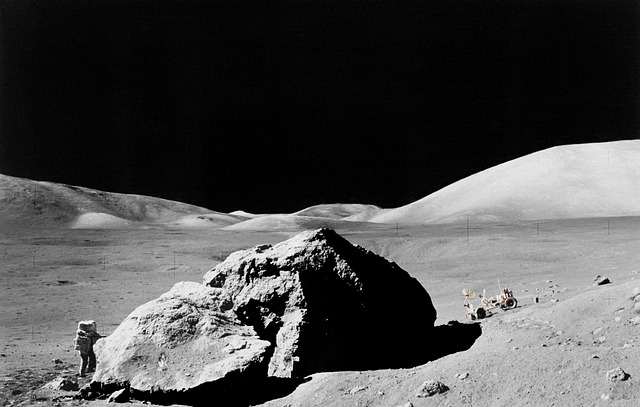
Somewhere in a laboratory at the University of Oxford, a small piece of the Moon sits under a light it has not seen for four and a half billion years. It is roughly the size of a thumbnail — grey, unremarkable, ancient beyond comprehension. And it has just answered a question that has nagged at planetary scientists since Neil Armstrong's crew brought it home.
Why were the Apollo Moon rocks magnetic?
The Moon, after all, has no magnetic field. It is a cold, quiet world with no molten churning core, no invisible shield deflecting the solar wind. Yet when NASA's astronauts returned from the lunar surface between 1969 and 1972, the samples they carried told a different story. Locked inside those rocks were unmistakable signatures of intense magnetism — evidence of a field that, at times, rivalled or even surpassed Earth's own.
For more than fifty years, the puzzle endured. How could something so small have generated something so powerful?
Now, in a study published in Nature Geoscience, a team led by Associate Professor Claire Nichols has finally cracked it — and the answer is as elegant as it is surprising.
Brief, brilliant bursts
The Moon did indeed produce an extraordinarily strong magnetic field. But not for long. Nichols and her colleagues found that these episodes of intense magnetism lasted no more than a few thousand years — and possibly as little as a few decades. In the context of a 4.5-billion-year history, they were over in the blink of a cosmic eye.
The key lay in titanium. By re-analysing the chemistry of the Apollo samples — a type of volcanic rock known as mare basalt — the researchers discovered a striking correlation: every rock that recorded a strong magnetic field was rich in titanium. Those with low titanium recorded only weak magnetism.
Their models suggest that when titanium-rich material deep inside the Moon melted near the core-mantle boundary, it briefly supercharged the lunar dynamo, generating a surge of magnetism before the system settled back to its usual feeble hum.
"Our new study suggests that the Apollo samples are biased to extremely rare events that lasted a few thousand years," said Nichols. "It now seems that a sampling bias prevented us from realising how short and rare these strong magnetism events were."
The beautiful accident of Apollo
There is a lovely irony buried in the finding. The Apollo missions all landed on the mare — the Moon's flat, dark volcanic plains — because they were safe places to set down a spacecraft. But those plains happened to be precisely where the titanium-rich rocks had pooled, capturing evidence of those rare magnetic storms.
Co-author Associate Professor Jon Wade put it perfectly: "If we were aliens exploring the Earth, and had landed here just six times, we would probably have a similar sampling bias."
Had the astronauts landed elsewhere, we might never have known the Moon had this extraordinary secret at all.
A golden month for human knowledge
The lunar discovery did not arrive alone. In the same remarkable month, CERN's Large Hadron Collider announced the discovery of its 80th particle — a new baryon composed of two charm quarks and a down quark, four times heavier than a proton. Detected by the LHCb experiment during the collider's third run, it brings physicists closer to understanding the strong nuclear force that holds all matter together.
March 2026 is shaping up to be one of those rare months when humanity's understanding of the universe lurches forward on multiple fronts simultaneously.
What comes next
Perhaps the most thrilling aspect of the Moon rock discovery is what it promises for the future. NASA's Artemis programme aims to return astronauts to the lunar surface before the decade is out — this time to regions the Apollo missions never reached.
"We are now able to predict which types of samples will preserve which magnetic field strengths on the Moon," said co-author Dr Simon Stephenson. "The upcoming Artemis missions offer us an opportunity to test this hypothesis and delve further into the history of the lunar magnetic field."
The Apollo samples were collected by twelve men between 1969 and 1972. They were sealed, stored, and studied across generations — handled with extraordinary care by scientists who trusted that future tools would unlock secrets their own instruments could not.
That patience has now been rewarded. And when Artemis lands, a new generation of Moon rocks will begin their own long, quiet wait for questions we have not yet learned to ask.