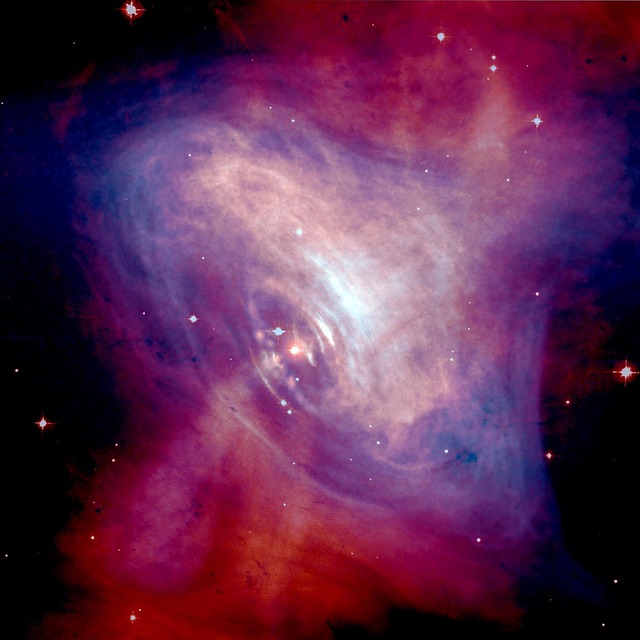
Nearly a thousand years ago, astronomers in China recorded a "guest star" so bright it blazed through the daytime sky for weeks. They had no way of knowing they were watching a star die. Today, from 6,500 light-years away, the aftermath of that explosion is still putting on a show — and NASA's Hubble Space Telescope has just captured it in breathtaking new detail.
The space agency released fresh images of the Crab Nebula on March 23, comparing views taken in 1999 with new observations from 2024. The result is a vivid, side-by-side record of a cosmic explosion still very much in motion — its glowing filaments of gas racing outward at 3.4 million miles per hour.
A millennium of wonder
The Crab Nebula, nestled in the constellation Taurus, is the remnant of supernova SN 1054 — one of the best-documented cosmic events in human history. Chinese, Japanese and Middle Eastern astronomers all noted the sudden appearance of a star bright enough to see in broad daylight.
What they witnessed was the violent death of a massive star. What remains is a stunning, tangled web of gas and dust, threaded with colour — blues marking the hottest, lowest-density regions, reds and yellows revealing energised sulphur and oxygen. At its heart sits a pulsar, a rapidly spinning neutron star no wider than a city, whose ferocious magnetic field powers the entire nebula's expansion.
"We tend to think of the sky as being unchanging, immutable," said astronomer William Blair of Johns Hopkins University, who led the new observations. "However, with the longevity of the Hubble Space Telescope, even an object like the Crab Nebula is revealed to be in motion, still expanding from the explosion nearly a millennium ago."
What Hubble found this time
The new images, captured with Hubble's Wide Field Camera 3 — installed by astronauts during the telescope's final servicing mission in 2009 — reveal previously unseen detail in the nebula's intricate filamentary structure.
Scientists discovered that the outer filaments have moved noticeably more than those near the centre, and rather than stretching like pulled toffee, they have simply shifted outward as a whole. This is because the Crab is a pulsar wind nebula — its expansion driven not by leftover shockwaves from the original blast, but by the relentless energy pouring from its central pulsar.
Perhaps most intriguingly, the team spotted shadows cast by some filaments onto the glowing synchrotron haze behind them — a clue to the nebula's three-dimensional structure. Some of the brightest filaments cast no shadow at all, meaning they must sit on the far side of the nebula, facing away from us.
The findings have been published in The Astrophysical Journal.
A remarkable month for science
The Crab Nebula images arrive during what is shaping up as an extraordinary month for discovery. In March 2026 alone, CERN's LHCb experiment announced the observation of a new doubly charmed heavy proton, while ESA revealed that artificial intelligence had identified more than 1,300 previously unknown cosmic anomalies lurking in Hubble's vast image archive.
Earlier this week, scientists at the University of Kansas announced they had finally cracked a 20-year mystery: the strange "zebra stripe" patterns in radio emissions from the Crab Pulsar itself, explained by a cosmic tug-of-war between gravity and plasma.
It is a reminder that even the most studied objects in the sky still have secrets to share.
Still looking up
Hubble, now more than 35 years into a mission originally expected to last 15, remains the only telescope with the combination of longevity and resolution to track changes like these. Its data is already being paired with infrared observations from the James Webb Space Telescope, which captured its own stunning portrait of the Crab Nebula in 2023.
Together, the old warhorse and its younger successor are building the most complete picture ever assembled of what happens in the centuries after a star dies — and how the raw materials of future worlds are scattered across the galaxy.
The next time you glance up at a clear night sky, Taurus will be there, low in the west as spring settles in. You cannot see the Crab Nebula with the naked eye. But it is there all the same — still expanding, still glowing, still telling the story of a star that died before William the Conqueror set foot in England.
And Hubble, our eye in the sky, is still watching.