
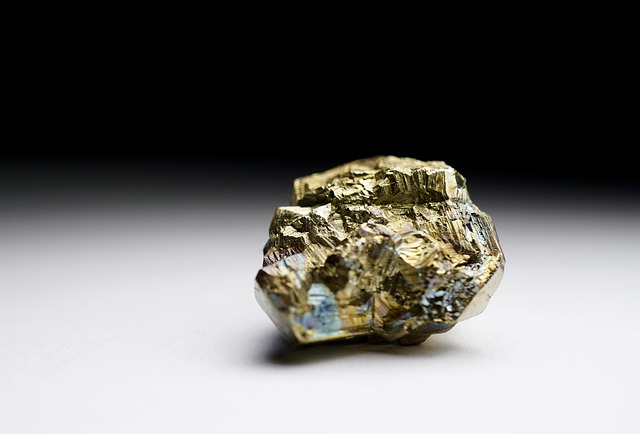
For centuries, miners cursed it. Prospectors who thought they'd struck it rich would lug home glittering lumps of pyrite — "fool's gold" — only to discover their fortune was, quite literally, worthless shine.
Turns out the fools may have been the rest of us.
Scientists at West Virginia University have discovered that pyrite in ancient shale rocks is hiding something far more useful than gold: lithium, the lightweight, fizzy metal at the heart of every electric car, laptop and solar-storage system on the planet.
A glittering surprise
The work was led by Shailee Bhattacharya, a doctoral student in sedimentary geochemistry, with Professor Shikha Sharma at West Virginia University's IsoBioGeM Lab. The team analysed 15 samples of middle-Devonian shale from the Appalachian basin — rock that formed roughly 380 million years ago, when the eastern United States lay beneath a warm inland sea.
What they found inside the pyrite crystals was, in Bhattacharya's own word, "unheard of": significant amounts of lithium, tucked away in a mineral nobody thought to check.
"I am trying to understand how lithium and pyrite could be associated with one another," she said. The honest answer, for now, is that no one quite knows — but the implications are already glittering.
The findings were presented as an abstract at the European Geosciences Union (EGU) General Assembly and summarised by the EGU press office and ScienceDaily. The work has not yet been published in a peer-reviewed journal, so the results should be treated as preliminary.
Why lithium matters
Lithium is the reason your phone charges, your laptop is banned from the hold of an aeroplane, and your neighbour's new EV glides silently past the petrol station.
It is wildly reactive — drop a chunk of pure lithium in water and it hisses, heats and releases flammable hydrogen — and that same twitchy chemistry is what makes it brilliant at shuttling energy in and out of a battery.
Demand has gone vertical. Every wind farm, every solar array, every electric bus needs somewhere to park its electrons, and at the moment lithium-ion is the best parking space we have. Most of the world's supply currently comes from pegmatite rock and South American salt flats — extraction methods that are thirsty, energy-hungry and not always kind to the landscape.
Mining the mines we've already dug
The real charm of the pyrite finding is not just that lithium is there, but where.
Pyrite turns up routinely in the waste rock left over from coal mining and oil-and-gas drilling — the so-called mine tailings and drill cuttings that already sit in spoil heaps across the Appalachians and beyond. If the lithium can be economically teased out of that existing material, it would mean new batteries without breaking new ground.
"We can talk about sustainable energy without using a lot of energy resources," Bhattacharya said.
There is also a neat chemical plot twist. Engineers have been working for years on lithium-sulfur batteries, a next-generation design that could outperform today's lithium-ion cells. Pyrite, conveniently, is an iron-sulfide mineral — the very rock that hides the lithium is itself made of the other ingredient the battery world is eyeing up.
Keep the champagne on ice
Bhattacharya is careful to temper the excitement. "This is a well-specific study," she warned. Fifteen samples from one corner of West Virginia do not a global supply chain make, and no one has yet worked out a clean, commercial way to separate the lithium from the pyrite at scale. The conference abstract will also need to run the gauntlet of peer review before it can be taken as settled science.
But the direction of travel is promising. If similar lithium-bearing pyrite is found in shales elsewhere — and shale formations blanket vast swathes of the planet — the humble fool's gold could quietly help power the green transition without another crater gouged into the earth.
Four hundred years of miners owe pyrite an apology. It wasn't fooling anyone. It was just waiting for the technology to catch up.