

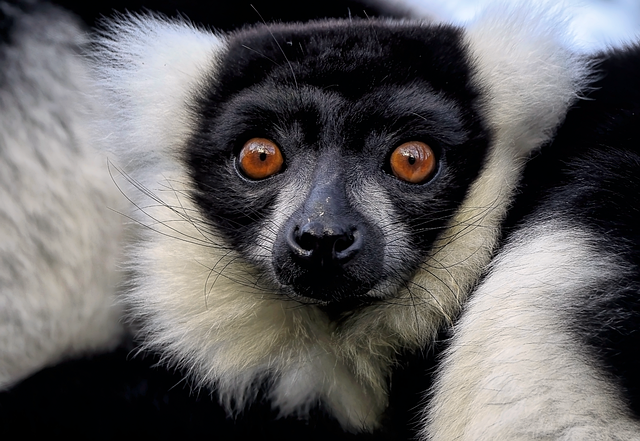
Red-ruffed lemurs at a Scottish safari park have given Glasgow researchers a charming answer to a question nobody had quite thought to ask before: would they like to share a sensory experience with a human stranger through a touchscreen?
Apparently, yes.
A University of Glasgow study has found that lemurs at Blair Drummond Safari Park not only engaged with a custom-built interactive system called CreatureConnect — they actively preferred using it collaboratively with visitors over having full control themselves. The findings will be presented as a paper at the CHI 2026 conference in Barcelona, and suggest that technology could open up a new kind of meaningful contact between species.
"Our findings suggest for the first time that we can not only share experiences with other species using technology, but that, in this case, red-ruffed lemurs want to share them with us and prefer sharing to solo control," said Dr Ilyena Hirskyj-Douglas, who leads Glasgow's Animal-Computer Interaction research group and is the paper's corresponding author.
How CreatureConnect works
The system was installed on either side of the lemur enclosure's glass partition for 20 days last year. On the animals' side, a box fitted with speakers, a screen and a scent-releasing device responded when a lemur approached. Drawing nearer turned up sounds — music, rainforest ambience — along with visuals such as underwater scenes and abstract patterns, plus the scents of apple, lavender and mango. Stepping back dialled everything down.
On the visitors' side, humans used touchscreen sliders to mix and adjust the stimuli when it was their turn at the controls. The team tested four modes: fully automatic, human-only, lemur-only, and shared human-lemur control.
A surprising preference for sharing
The numbers tell a sweet story. More than 16,000 people visited the lemur enclosure during the trial. Of those, 1,719 used the system, and the lemurs themselves chose to interact with it 541 times. Crucially, the lemurs were least engaged when they had full control of the device — and most engaged when they shared it with a human. They had clear preferences, too: high-intensity scents, bright visuals, and medium-volume sound.
Visitors, for their part, stayed longer at the enclosure, watched the animals more closely, talked more about lemur behaviour and welfare, and reported a stronger sense of connection when they could see the lemurs reacting to their choices.
"When we were designing the system, we suspected that humans would respond more strongly to shared control than the lemurs, and that lemurs would prefer to do their own thing," said Jiaqi Wang, the paper's first author and a PhD student at Glasgow's School of Computing Science. "We were surprised to find that the lemurs do not necessarily want to control the device alone. Instead, they seem to want to share."
The conservation hook
For Blair Drummond's research coordinator Lorna Graham, the real magic was in those shared moments. "When people can see the lemurs responding and making their own choices, something really seems to click," she said. "That shared moment creates a genuine connection — and when you feel connected to an animal, you're far more likely to care about its future."
That is, ultimately, the point. Red-ruffed lemurs are critically endangered in the wild, and the Glasgow team believe technology-mediated empathy could nudge zoo visitors toward becoming wildlife advocates. Dr Hirskyj-Douglas is already eyeing the next frontier: less obviously cuddly species.
"What might happen if we were to try this with a spider, or an insect, or another animal that visitors might be less naturally drawn to?" she said. "It's hard to make people care about a part of the natural world they've never felt a connection with."
If a touchscreen and a whiff of mango can build that bridge, even an arachnid might one day get its turn at the slider.