
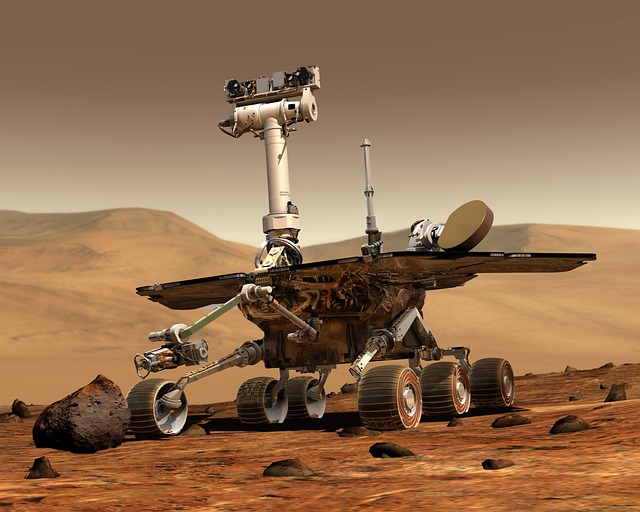
A little robot the size of a Mini Cooper has just handed humanity its most tantalising clue yet that Mars might once have been a place where life could take hold.
NASA's Curiosity rover, plodding patiently across the Red Planet since 2012, has identified seven organic molecules never before detected on Mars — pulled from a single, unassuming rock drilled five years ago on the slopes of Mount Sharp. The findings were published on 21 April in Nature Communications.
Among the new arrivals is a nitrogen heterocycle — a ring-shaped molecule that scientists describe as a chemical ancestor of RNA and DNA, the very stuff that carries the genetic code of every living thing on Earth.
"That detection is pretty profound," said the paper's lead author, Dr Amy Williams of the University of Florida. "These structures can be chemical precursors to more complex nitrogen-bearing molecules. Nitrogen heterocycles have never been found before on the Martian surface or confirmed in Martian meteorites."
A rock named after a fossil hunter
The sample is nicknamed "Mary Anning 3," after the trailblazing 19th-century English palaeontologist who unearthed the first ichthyosaur and plesiosaur fossils. It's a fitting tribute: the rock came from a patch of Mount Sharp that, billions of years ago, was an oasis of lakes and streams.
That ancient water did something rather marvellous. As it surged and dried up over the eons, it left behind clay minerals — and clay, it turns out, is brilliant at locking organic molecules safely inside rock, sheltering them from the brutal radiation that has scoured the Martian surface ever since.
In total, the team found 21 carbon-containing molecules in the sample. Seven were new to Mars, including benzothiophene, a sulphur-bearing compound also found in meteorites and thought by some scientists to have helped seed the chemistry of life across the early solar system.
What it means — and what it doesn't
Here's the careful bit: nobody is saying NASA has found life. The molecules could have formed through biology, or through perfectly ordinary geological chemistry. Both routes are possible.
But — and it's a thrilling but — the discovery confirms once again that ancient Mars had the right ingredients on the shelf. The cupboard, in other words, was stocked.
"This is Curiosity and our team at their best," said mission project scientist Dr Ashwin Vasavada of NASA's Jet Propulsion Laboratory. "It took dozens of scientists and engineers to locate this site, drill the sample, and make these discoveries with our awesome robot. This collection of organic molecules once again increases the prospect that Mars offered a home for life in the ancient past."
How a robot does chemistry on another planet
Curiosity's secret weapon is a shoebox-sized lab in its belly called SAM — Sample Analysis at Mars. The rover drills a rock with its robotic arm, grinds the bits to powder, and trickles them into SAM, which heats them in a tiny oven and sniffs the gases that come off.
For this sample, scientists used one of just two precious cups of a chemical called tetramethylammonium hydroxide, which gently breaks larger molecules apart so they can be identified. They saved it for Mary Anning 3 because they knew it was special.
To double-check the results, the team performed the same trick on a fragment of the Murchison meteorite back on Earth — a four-billion-year-old space rock studded with organics. The match held up.
A growing list
Last year, Curiosity unearthed the largest organic molecules ever found on Mars — long-chain hydrocarbons called decane, undecane and dodecane. Add the new seven, and the picture is starting to look less like a barren desert and more like a planet that, once upon a very long time ago, was warming up the kettle.
Curiosity is now nosing around an area of weblike rock ridges carved by ancient groundwater. Whatever it finds next, the rover that was supposed to last two years — and is currently in its fourteenth — has done it again.
Mars, it seems, is still happy to talk. We just have to keep listening.