

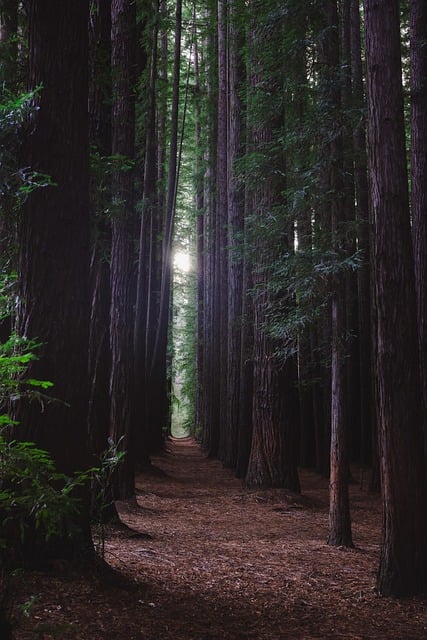
The access road grew over. The project sign fell down. And for the better part of three decades, one of Australia's most ambitious forestry experiments sat in the hills, forgotten by almost everyone.
The trees, however, kept growing.
That is the story told by a team of University of Melbourne researchers, who went back to the site and, in a study published in July, report what they call "astounding" results: giant trees, carbon stocks to match unharvested forest and a rare marsupial, all in forest that had been logged.
A trial lost to the undergrowth
In the mid-1980s the government of the Australian state of Victoria invested the equivalent of A$26 million in today's money to explore alternatives to clearfelling, where every tree in a block of forest is cut down, the researchers write in The Conversation.
The Silvicultural Systems Project was set up between 1987 and 1989 at two sites, one of them Tanjil Bren in the state's Central Highlands. The forest there was dense mountain ash, a towering eucalypt and no relation to the rowan that Scots know by the same name, which had regrown after bushfires in 1939.
Foresters tried several approaches side by side: large clearfells, small cleared patches and heavy thinning, in which 50 to 70 per cent of the trees were cut and the rest left standing with more space and resources. Stretches of unharvested forest were kept for comparison.
By the early 2000s the verdict seemed clear. Mountain ash regenerated best on the clearfelled sites. The findings were published, and the experiment slipped from memory.
What they found
In 2014 the Melbourne team visited Tanjil Bren with students, at the suggestion of a colleague, Simon Murphy, who had helped to establish the trial.
The original result still held, they report. But it was the heavily thinned forest that caught their attention. The trees left behind were only 80 years old, yet the largest averaged well over a metre in diameter at chest height, and some were more than 1.5 metres. The largest were 20 per cent bigger in diameter than those in the unharvested areas.
"More remarkable still: the thinned stands of trees had stored as much or more carbon in their wood than the unharvested control areas," write Kaitlyn Hammond, Craig Nitschke, Patrick Baker and Raphael Trouve.
Then there were the possums. Camera traps recorded Leadbeater's possums, a rare species, in every harvested treatment plot the team surveyed, and in none of the unharvested areas. The researchers point to the acacia that sprang up in most of the treated areas, which the possums use to forage and to move around the forest.
The study, published in the journal Forest Science, compared seven harvesting treatments with unharvested controls across 53 plots.
What it does and does not settle
The authors call thinning "a win-win-win outcome that challenges the false dichotomy of conservation versus production that has dominated public debate for decades".
They are also careful about its limits. Thinning "cannot (and should not) be done everywhere", they write, and "there is no silvicultural silver bullet for managing forests".
A few further cautions are worth keeping in mind. These results come from one forest type at one long-running trial. The carbon figures refer to carbon stored in the trees' wood. Camera traps show where possums were recorded, not how their numbers fare over time. And the same experiment found that clearfelling regenerated mountain ash best, which was the foresters' original argument.
All of the findings and quotations here come from the study's own authors, and this report does not include independent comment. Two of the four authors declare research funding from an Australian forest and wood industry innovation body, among other funders.
Closer to home
Scotland has a long-lived experiment of its own. The Glentress Trial Area was established in 1952 by Professor Mark Anderson of the University of Edinburgh, and the Scottish Forestry Trust describes it as one of the longest-running continuous cover forestry trials in the world.
Forest Research, which still works there with Forestry and Land Scotland, says thinning is one of the main tools for moving woodland away from clearfelling. Across Britain, it estimates, continuous cover methods have been adopted in more than 10 per cent of woodlands in the public forest estate.
Different trees and a different climate mean the Australian findings cannot simply be read across. The lesson that travels is the researchers' first one, about forgotten experiments: "We should find them before it is too late."